
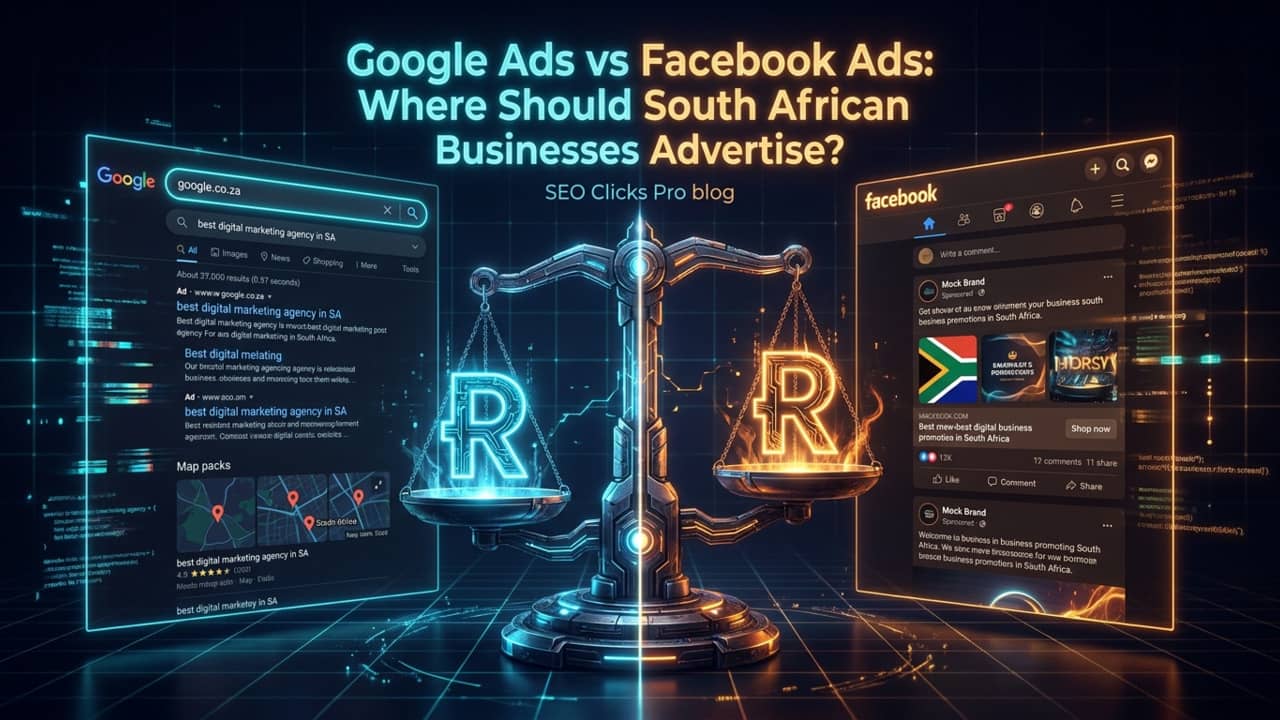
South African businesses have more advertising options than ever, but two names dominate the conversation: Google Ads and Facebook Ads. Both can generate enquiries, but they work in fundamentally different ways. Choosing the wrong one means wasted budget. Choosing the right mix can transform your lead flow.
This guide compares Google Ads vs Facebook Ads for South African businesses, explains which suits which situation and shows how a PPC agency approach to paid media can protect your spend.
How Google Ads works
Google Ads management places your business in front of people who are actively searching for what you sell. When someone searches "emergency plumber in Cape Town" or "SEO agency Johannesburg," your ad appears above the organic results. The intent is already there.
This is paid search at its best: capturing existing demand. It is fast, measurable and direct. The trade-off is that you pay for every click, and clicks in competitive markets can be expensive.
How Facebook Ads works
Facebook Ads places your business in front of people based on demographics, interests and behaviour, rather than active search intent. Instead of catching someone mid-search, you create demand by showing the right message to the right audience.
This is social media advertising: building awareness and interest over time. It is excellent for brand discovery, retargeting and visual products, but it usually takes more impressions before someone acts, and tracking true ROI is harder.
The core difference: intent vs interest
The simplest way to decide between Google Ads vs Facebook Ads is intent.
- Google Ads captures people who already want your service. They are further down the funnel and closer to buying.
- Facebook Ads reaches people who might want your service. They need education, trust and repeated exposure before they convert.
For a business selling urgent or considered services, Google Ads management is usually the faster route to enquiries. For a brand launching something new, or a product with strong visual appeal, Facebook Ads can build demand that search alone cannot create.
Where each channel wins in South Africa
Choose Google Ads when:
- You sell a service people search for with commercial intent, like roofing, legal advice or accounting.
- You need enquiries within days, not months.
- Your market is competitive and organic rankings take time to build.
- You can track calls, form submissions or sales back to specific clicks.
Choose Facebook Ads when:
- You sell a visual or emotional product, like furniture, clothing or hospitality.
- You are building a brand from scratch and need awareness first.
- Your audience can be defined by interests, life stage or location.
- You plan to retarget website visitors with follow-up messages.
Why PPC quality matters
Here is the part most people miss. A PPC campaign is only worth the money when the clicks are real and the traffic converts. In South Africa, click fraud and low-quality traffic are genuine problems. Budgets disappear on bot clicks, repeat networks and no-intent visitors.
That is why we built a PPC traffic quality audit. It provides forensic evidence of where your ad spend actually went, identifies wasted traffic and shows what a clean campaign should look like. Before scaling any Google Ads budget, know your traffic quality.
How a paid media strategy fits together
Most successful businesses use both channels, but in sequence, not randomly. A common pattern for a South African service business:
- Run Google Ads on high-intent keywords to generate enquiries immediately.
- Use Facebook retargeting to stay in front of people who visited but did not contact.
- Build organic SEO underneath so paid dependence drops over time.
- Audit traffic quality regularly so spend is not leaking.
This is the paid media approach we use at SEO Clicks Pro. Our Google Ads management focuses on genuine enquiries rather than vanity clicks, and it connects cleanly to the rest of your digital system.
Budget considerations for South African businesses
Budget is a deciding factor for most small businesses choosing between Google Ads vs Facebook Ads. Google Ads costs per click, and the cost depends on competition in your market. Legal services, insurance and high-value B2B keywords can be expensive. Niche trades and local services are usually more affordable.
Facebook Ads costs per impression or per click, and the cost depends on audience targeting and creative quality. The platform rewards relevance. A well-targeted, well-designed Facebook ad can be very cost-effective. A poorly targeted ad wastes money regardless of the budget.
For a South African business with a limited budget, Google Ads management often delivers faster results for service-based businesses because the intent is already there. Facebook Ads works better when you have a clear audience profile, strong visuals and a longer sales cycle that allows for retargeting.
Tracking and attribution differences
One of the biggest differences between Google Ads and Facebook Ads is how you track results. Google Ads integrates directly with Google Analytics and Google Search Console, making it relatively easy to see which clicks led to which enquiries. You can track calls, form submissions and e-commerce transactions with clear attribution.
Facebook Ads attribution is more complex. The platform uses its own pixel and conversion tracking, but the connection between an ad view and a later action is harder to measure. Changes to iOS privacy settings have made Facebook tracking less reliable than it was.
This is where a PPC agency approach adds value. A professional setup includes tracking across both platforms, consistent naming conventions and a clear view of cost per enquiry. Without tracking, you are choosing channels based on faith, not evidence.
When to use both channels together
The most effective paid media strategies often use both channels in a coordinated way. Google Ads captures demand from people who are already searching. Facebook Ads builds awareness among people who do not yet know they need you. Together, they cover the full funnel.
A practical example: a roofing company runs Google Ads on "emergency roof repair" and "roofing contractor Cape Town" to capture immediate demand. Simultaneously, it runs Facebook retargeting ads to people who visited the site but did not contact, plus awareness ads aimed at homeowners in specific suburbs. The two channels reinforce each other.
Whether you use one channel or both, protecting your budget with traffic quality checks is essential. A PPC traffic quality audit reveals which clicks are real, which are bot traffic and which are wasted, so you can adjust before the budget is gone.
Let us recommend the right paid media mix.
Tell us what you sell, who buys it and how quickly you need results. We will show you where the budget should go.
Get a paid media recommendationFinal thoughts on Google Ads vs Facebook Ads
There is no universal winner. Google Ads wins when demand already exists and you want to capture it. Facebook Ads wins when you need to create demand and build familiarity. For most South African businesses, the smart move is to start with the channel that matches your most urgent need, protect the budget with traffic quality checks, and layer the second channel in as results justify it.