Fast business websites

Building better website systems for speed and growth.

Custom-coded business websites with clean architecture, strong performance, clear service journeys and no unnecessary content-management overhead.

What this service solves

A simpler website stack can produce a faster, cleaner and more dependable business site.

SEO Clicks Pro uses static website architecture when the business benefits more from speed, stability and simplicity than from a database-driven CMS. Static websites serve prepared HTML, CSS, JavaScript and media files without generating every page from a database. For many brochure, service and lead-generation websites, this removes complexity while improving speed, stability and security.

We design the site around business goals first: clear services, useful page hierarchy, mobile usability, credible messaging and direct contact paths. The static architecture then supports those goals with efficient delivery and a much smaller executable surface.

I also use static builds as a recovery option when a WordPress site has become the source of crawl noise. The practical reasoning is explained in static websites as an SEO recovery tool.

Common warning signs
  • The current website is slow, bloated or difficult to maintain.
  • A simple business site is carrying unnecessary CMS complexity.
  • Service information is buried or poorly structured.
  • The mobile experience is cramped or confusing.
  • The site looks acceptable but produces few enquiries.
  • Security and update problems consume ongoing attention.

Is static the right architecture for you?

Static websites are powerful when the content model is simpler than the CMS overhead.

We use the architecture because it fits the operating reality of the site, not because static is fashionable.

Excellent fit

A brochure or lead-generation site changes deliberately, not every hour

Service businesses, professional firms and focused campaign sites often benefit from fewer moving parts, fast delivery and a small attack surface.

Use static as the default simplicity layer.
Hybrid fit

Most pages are stable, but one area needs publishing or dynamic features

A static front can coexist with a blog, store, portal or API-driven component when those systems are isolated to where they add value.

Keep complexity contained to the part that needs it.
Wrong fit

Editors, users or inventory need constant database-driven interaction

If the business needs complex permissions, live catalogues, customer accounts or frequent non-technical publishing, a CMS or application may be the better core.

Choose the platform around operations, not ideology.

What is included

A static build removes complexity where the business does not need it.

Scope depends on what the site must actually do. We keep the build static by default and add dynamic capability only where the business case requires it.

01

Custom responsive design

A layout built for the brand, services and customer journey across desktop and mobile.

02

Service-page architecture

Focused pages that can target commercial search intent without overloading the homepage.

03

Technical SEO setup

Titles, descriptions, canonicals, sitemap, robots, structured data and clean status behaviour.

04

Performance engineering

Efficient assets, sensible loading, compression and cache controls.

05

Security hardening

Restricted executable endpoints, query-string controls and protection for private or operational files.

06

Launch and handover

Deployment support, testing, analytics setup and a clear maintenance path.

Complexity budget

Use dynamic infrastructure only where the business genuinely benefits from it.

A website carries operational cost in every moving part. Static architecture keeps the default simple and adds complexity deliberately.

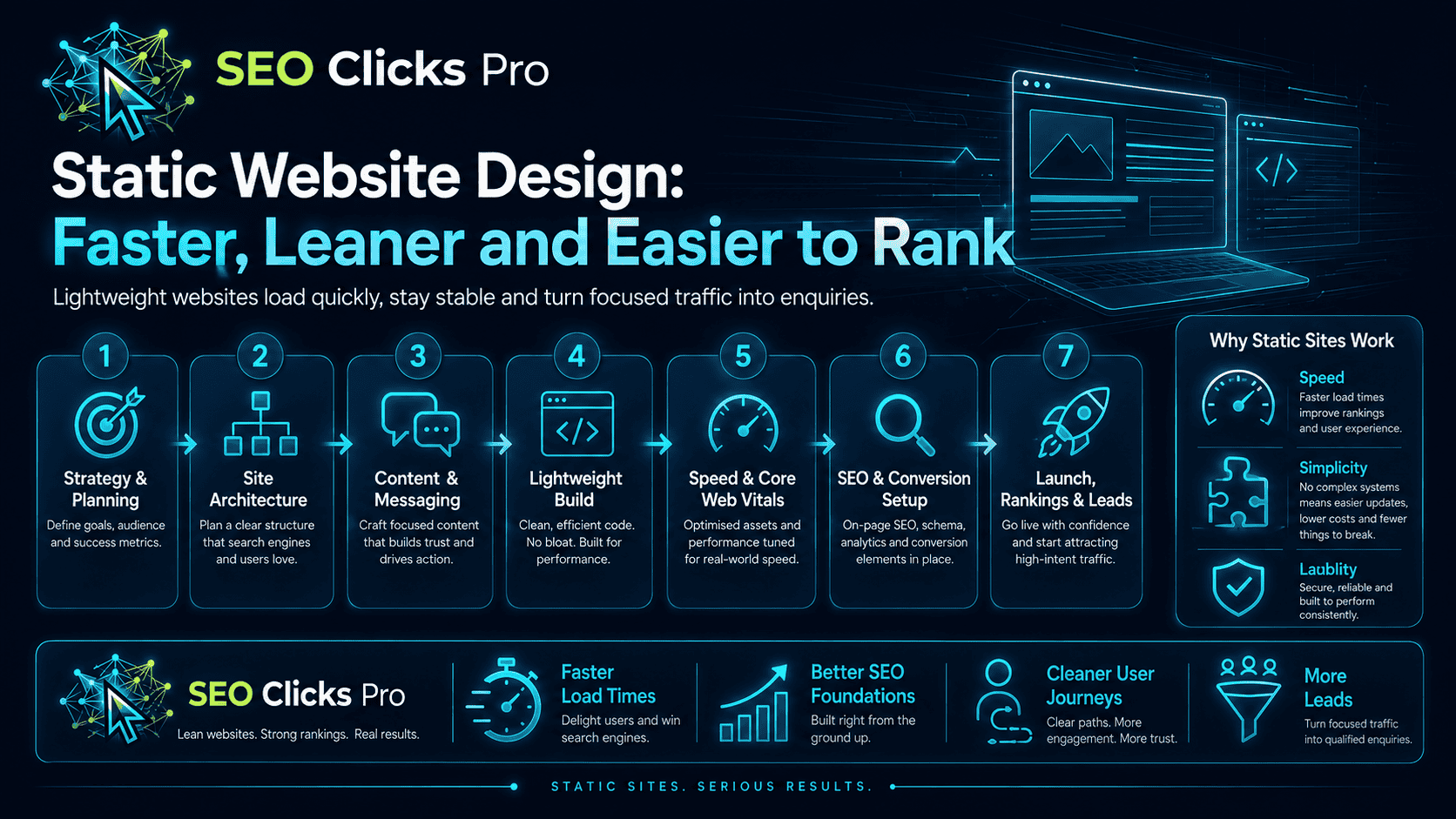
Static website design workflow showing strategy, site architecture, content, lightweight development, Core Web Vitals, SEO setup and launch for faster lead-generation websites.
SEO Clicks Pro static website design model for fast, stable, search-ready business sites.

Business outcomes

The payoff is speed, stability and a site that is easier to reason about.

Faster delivery

Visitors receive lean pages without database and plugin processing on every request.

Smaller attack surface

The public site contains far less executable application code.

Clearer SEO structure

Services, locations and contact journeys are organised into crawlable, focused pages.

Our process

We plan the information architecture before writing the markup.

We map pages and conversion paths, design the system, build semantic markup and test performance, redirects, forms and metadata before launch.

01

Plan the conversion journey

We define audiences, services, proof, actions and the pages required to support them.

02

Design the system

Visual direction, reusable components and responsive behaviour are established.

03

Build and optimise

Pages are coded, tested, compressed and equipped with clean SEO foundations.

04

Launch safely

We validate forms, links, headers, redirects, sitemap, mobile behaviour and tracking.

Why SEO Clicks Pro

A fast site still needs conversion, search and maintenance decisions.

A static site can still need SEO, maintenance and campaign infrastructure; the difference is that those systems are added deliberately rather than inherited from a CMS.

Discuss your project
  • The website is designed around enquiries and search visibility, not a generic theme.
  • Static architecture is used where it genuinely suits the business model.
  • Security and malformed-URL behaviour are considered during the build.
  • Future service and location pages can be added within the same design system.

Frequently asked questions

Questions about Static Website Design.

Send the current site or page list and the features you truly need; we can tell you where static, hybrid or dynamic architecture makes sense.

Ask about this service
Can a static website have forms?

Yes. Forms can submit to a carefully controlled local endpoint or a trusted external form service. The rest of the website can remain static.

Can I update a static website?

Yes. Updates are made by editing the site files or through a structured content workflow. For businesses that rarely change core pages, this can be simpler than maintaining a full CMS.

Are static websites good for SEO?

They can be excellent for SEO because they are fast, predictable and easy to structure cleanly. Rankings still depend on useful content, relevance, authority and correct technical implementation.

Do static sites support videos and galleries?

Yes. Static architecture does not prevent modern front-end features. Video, galleries, animations, forms and interactive components can all be included.

When is WordPress a better choice?

WordPress can be more suitable when non-technical users need frequent publishing, complex membership, ecommerce or plugin-driven workflows. We choose the architecture according to the business need.

Platform decision

Not sure whether static is right for you?

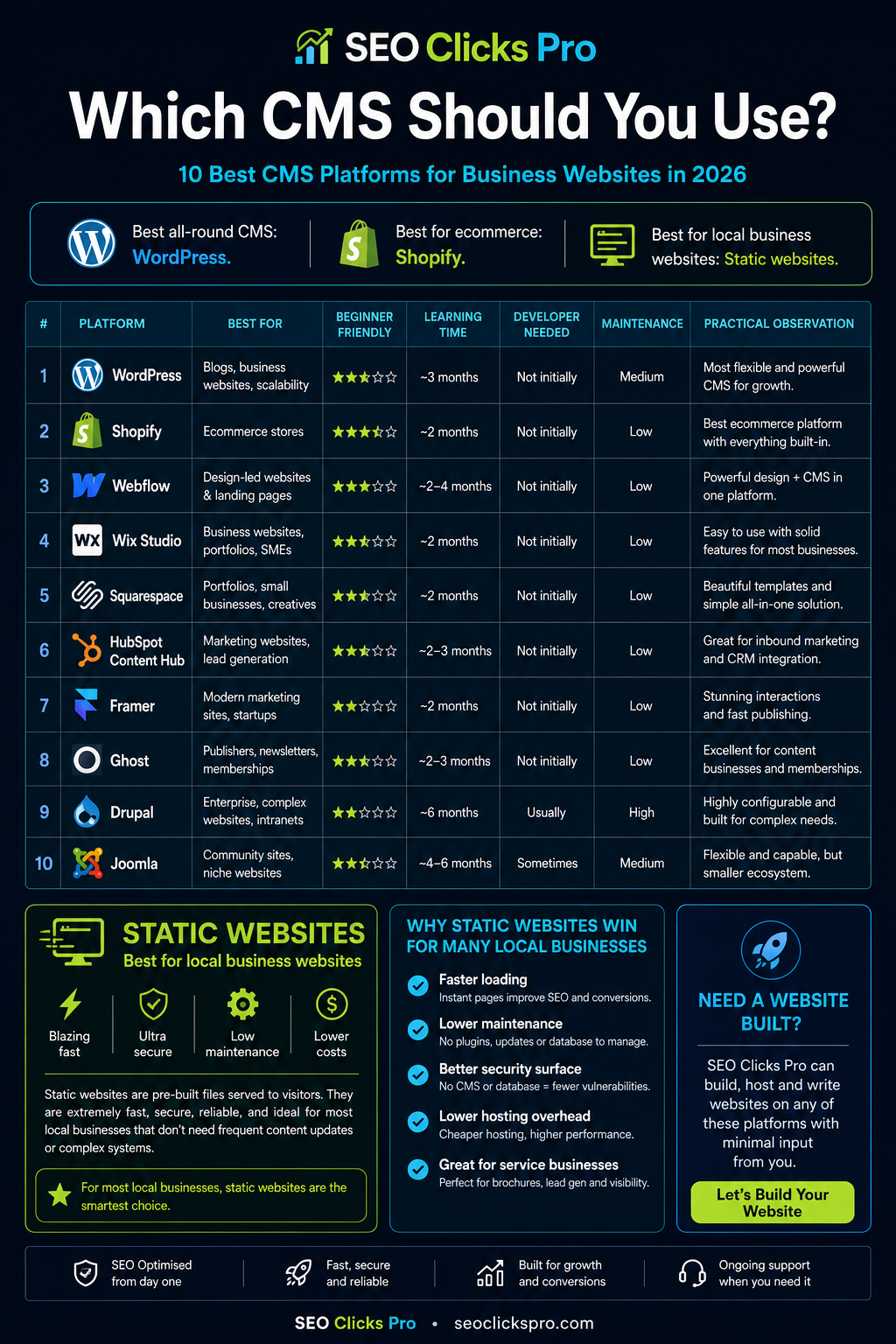
Compare static websites with WordPress, Shopify, Webflow, Wix Studio, Ghost, Drupal and other CMS options by speed, learning time, maintenance and business fit.

Compare website platforms

Website platform comparison

Static websites are often the strongest fit for local businesses — but they are not the only option we build.

SEO Clicks Pro can design, build, host and write websites across the major platforms. This branded comparison shows where each option tends to fit, with static websites highlighted for local businesses that value speed, security and low maintenance.

SEO Clicks Pro website platform comparison. Tap or click to inspect it at high zoom.

Start a conversation

Need a fast business website without carrying a CMS you do not need?

Tell us who needs to edit the site, how often content changes and what functionality would be painful to lose.