
Crawl and index report
A clear inventory of indexable pages, blocked URLs, redirects, errors and discovered junk.
Website SEO diagnostics
A forensic review of how search engines access, interpret and index your website-translated into a prioritised implementation plan.
What this service solves
SEO Clicks Pro starts technical SEO with evidence: reproduce what crawlers and servers actually return before deciding what needs to change. A website can look perfect in a browser while sending confusing signals to search engines. Redirect chains, duplicate URLs, incorrect canonicals, blocked resources, soft 404s, query-string pollution and weak internal discovery can all reduce the value of otherwise strong content.
Our technical SEO audit follows the path from request to response: what URL was requested, what the server returned, whether Google can crawl it, which canonical is declared, how the page is linked and whether the index receives a clean, consistent signal.
I have written separate field notes on indexing recovery after WordPress bloat and why 404 cleanup is not the same as SEO cleanup. Those are the kinds of issues I look for when a site has been crawled, but not properly trusted.
Technical diagnosis
We move from what you can observe to what a crawler can prove, then to the URL rule or system behaviour that caused it.
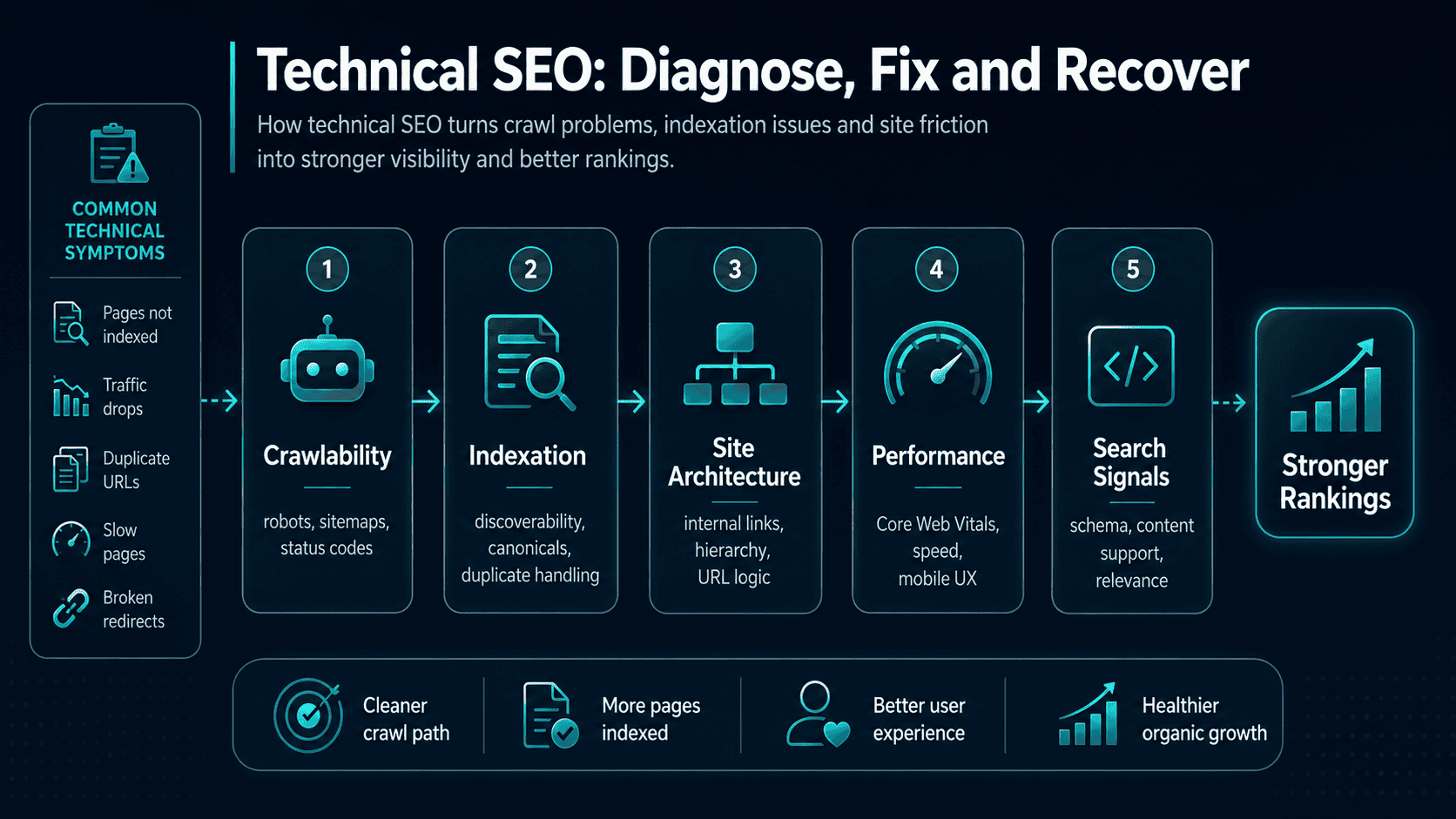
What is included
Audit scope follows the symptom and the site’s complexity; we do not force every site through an identical 200-point checklist.
A clear inventory of indexable pages, blocked URLs, redirects, errors and discovered junk.
Verification of 200, 301, 302, 403, 404, 410 and 5xx behaviour across important URL classes.
Checks for self-referencing canonicals, duplicate variants and Google-selected canonical conflicts.
Validation of robots.txt, XML sitemap content and crawl accessibility.
Core front-end issues that can affect usability, crawling and conversion.
Issues ranked by business impact, risk and implementation order.
Business outcomes
Search engines spend more attention on real pages and less on noise.
Important URLs consistently identify themselves as the preferred versions.
Technical findings are converted into specific fixes rather than an unreadable export.
Our process
We reproduce the issue at URL level, trace it to the rule or system that causes it, prioritize by impact and recrawl after implementation.
We review Search Console, sitemaps, server responses, internal links and a controlled crawl.
Real pages, redirects, blocked resources, errors and pollution patterns are separated.
We identify whether the issue sits in HTML, hosting, rewrite rules, CMS behaviour or linking.
Fixes are tested against clean pages, malformed requests and Google-facing signals.
Choose the diagnostic depth
A healthy 30-page site with one indexing mystery should not be audited like a migration, a bloated WordPress install or a site recovering from a technical collapse.
A money page will not index, a canonical keeps changing, redirects behave strangely or Search Console reports a problem you cannot reconcile with the browser.
Trace the specific symptom to URL-level evidence.Plugins, templates, parameters, duplicate URLs, legacy redirects and inconsistent directives have built up and nobody has one clean picture.
Map the entire crawl and index system.When URLs, hosting, CMS behaviour or security events changed, the job is to reconstruct what search engines saw before and after.
Compare states, isolate losses and validate recovery.Why SEO Clicks Pro
Technical SEO often crosses hosting, WordPress, static routing and content architecture, so we follow the behaviour across those boundaries.
Discuss your projectFrequently asked questions
Send the URL, Search Console symptom and anything that changed before it appeared; that gives us a useful starting hypothesis.
Ask about this service →The exact scope depends on the site, but typically includes crawlability, indexation, canonicals, redirects, status codes, sitemaps, robots directives, internal links, structured data, performance and URL duplication.
An audit identifies and prioritises the problems. We can also implement the fixes when access and platform constraints allow.
It is extremely useful because it shows how Google has actually discovered, crawled and indexed the site. We can still perform an external audit without it, but the evidence will be less complete.
Yes. Static sites can be very strong technically, but hosting rules, canonicals, query handling, redirects and internal discovery still need to be correct.
A full audit is valuable after a rebuild, migration, security incident or unexplained ranking change. Lighter monitoring can then identify new issues before they become large.
Technical SEO for UK firms
The UK SEO pages connect technical findings to B2B architecture, commercial content, AI-search readiness and implementation priorities delivered from South Africa.
Explore SEO Services UK →Start a conversation
Tell us what you see, when it started and whether the site was migrated, rebuilt, hacked or reconfigured around the same time.