
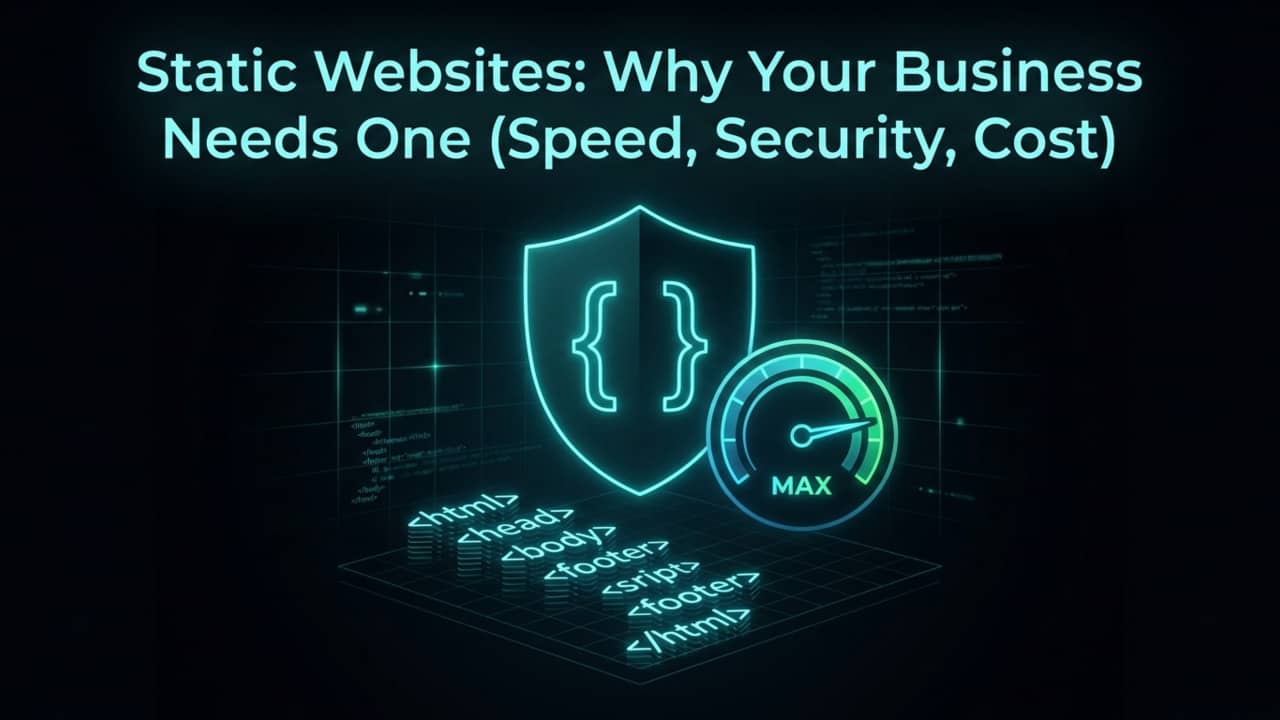
When most business owners think about website design, they picture WordPress, a drag-and-drop builder or a developer handed a brief. Fewer people know about static websites, and even fewer realise how often a static site is the better choice for a business website.
This article explains what a static website is, why it can outperform a heavy CMS for many South African businesses, and when the opposite is true.
What is a static website?
A static website is a site made of fixed HTML, CSS and JavaScript files. Every visitor sees the same content, served directly from the server or a content delivery network, without a database query or a server-side application running on each request.
There is no CMS admin panel, no plugin system and no login page to secure. The site is just files. That simplicity is the source of its advantages.
Why speed matters more than ever
Page speed is a ranking factor, a conversion factor and a user-experience factor. In South Africa, where mobile data is expensive and connections vary, a slow website costs real enquiries.
A static website is fast by default. Because there is no database query and no theme processing on every page load, pages render in a fraction of the time of a typical WordPress site. Faster pages mean more visitors stay, more visitors convert and Google ranks you more favourably.
If your current site takes five seconds to load, the fix is not a new plugin. It is a different architecture. This is where a web design agency that understands performance makes a real difference.
Security: fewer moving parts, fewer attacks
WordPress powers a huge share of the web, which also makes it the most attacked platform on the internet. Plugins, themes and core software all need constant updates, and every one is a potential entry point.
A static website has dramatically less attack surface. There is no admin login to brute force, no plugin vulnerability to exploit and no database to inject into. For a business that does not need a CMS, this is a serious advantage. When security work is still needed, our WordPress security service covers the platforms that do use a CMS.
Lower maintenance, lower cost
Website maintenance for a static site is minimal. No core updates, no plugin conflicts, no database backups to manage. Content changes are made to files and deployed. That simplicity reduces both cost and risk.
That said, every website still needs care: uptime monitoring, SSL renewals, content updates and technical checks. Our website maintenance service covers these regardless of the technology underneath.
When a static website is the right choice
A static website design is an excellent fit when:
- Your site exists to present services and generate enquiries, not to publish daily content.
- Speed and security are priorities.
- You do not need an admin panel where staff log in to edit pages.
- Your content changes occasionally, not hourly.
For a service business, a professional services firm, a property developer or a local trade, this describes most websites. A website design company that recommends a static build is often saving you money and future headaches, not cutting corners.
When WordPress is still the right choice
Static is not always the answer. WordPress makes sense when you need a blog with many authors, e-commerce functionality, membership systems, complex user roles or constant content updates. For those projects, proper WordPress security and website management become essential.
The honest position is that the technology should follow the requirement. What matters is that the site is fast, secure, clear and built to convert. That is exactly how we approach every static website design project at SEO Clicks Pro.
What a great business website needs
Technology is one part of the equation. The rest is structure and messaging:
- A headline that states what you do and who it is for.
- A clear path to contact, above the fold.
- Proof: reviews, case studies, past work.
- Fast, mobile-friendly pages on any connection.
- Tracking that shows where enquiries come from.
A landing page applies the same principles to a single campaign, while the main site handles the complete picture. Together with SEO services, they form a system that attracts, converts and measures.
Static vs dynamic: the difference explained
A dynamic website, like WordPress, generates pages on the fly by pulling content from a database. Every page load requires a database query, PHP processing and theme rendering. This is powerful for complex sites, but it adds weight and potential failure points.
A static website serves pre-built HTML files. There is no database query, no server-side processing and no theme to render. The page is served as-is, which is dramatically faster and more secure. For a business website that needs to present services, generate enquiries and build trust, this is usually the better architecture.
This does not mean static sites are primitive. Modern static sites can include interactive elements, animations, forms and dynamic content through JavaScript and third-party services. You get the speed and security of static files with the functionality users expect. A web design agency that understands both approaches can recommend the right one for your specific needs.
How static websites handle forms and updates
One concern businesses often raise is how a static website handles forms if there is no backend database. The answer is form processing services. Contact forms, newsletter sign-ups and enquiry forms can be handled by third-party services that receive the form data and forward it to your email or CRM. The user never notices the difference.
Content updates are handled through a simple workflow: edit the HTML file, deploy it to the server. For businesses that do not need a full CMS, this is actually simpler and faster than logging into a WordPress dashboard, finding the right page, making changes and hoping the plugin updates do not break anything.
For businesses that want an admin interface without the complexity of WordPress, a headless CMS can be paired with a static site. This gives you a dashboard for content editing while the public-facing site remains static. It is a middle ground that combines the best of both approaches.
Who should choose a static website
A static website design is the right choice for:
- Service businesses, professional practices and trades that need a clear, fast, trustworthy front door.
- Property developers, architects and portfolio sites that prioritise visual impact and speed.
- Businesses that have been burned by WordPress security issues and want a simpler alternative.
- Companies that do not need multiple content authors or complex user roles.
- Any business that values speed, security and low maintenance over CMS flexibility.
If that describes your situation, a website design company that recommends a static build is probably giving you honest advice. If a developer recommends WordPress without asking about your actual needs, ask why. The answer should be about your business, not their comfort zone.
A static website could be the upgrade you need.
We design static sites that load fast, stay secure and convert visitors into enquiries, without the CMS overhead.
Discuss a static websiteThe bottom line
For most South African business websites, a static website is the strongest foundation: fast, secure, low-maintenance and conversion-focused. If your current site feels slow or fragile, the technology might be the problem. Ask a web design agency whether a static build fits your business before you renew another year of platform subscriptions.