
Entity confusion
Inconsistent names, services, locations and relationships make the company harder to identify reliably.
AI search visibility for US brands
Strengthen how search engines, answer systems and AI assistants understand the company through clear entities, useful answers, structured evidence and controlled automation.
Search is expanding
Generative answers introduce new discovery paths, but they do not make technical SEO, clear content or authority irrelevant. Systems still need accessible pages and consistent information before they can interpret a company confidently.
AI SEO adds a retrieval and citation lens to the established search foundation. The work examines whether important questions are answered directly, whether claims are supported and whether the business entity remains coherent across sources.
Agentic workflows can increase monitoring and organization capacity. They do not receive unrestricted authority to publish commercial claims or alter live systems without agreed review.
The commercial problem
Ambiguous entities, unsupported claims and fragmented answers reduce confidence for people and machines.
Inconsistent names, services, locations and relationships make the company harder to identify reliably.
Promotional pages may never provide the direct definitions, comparisons and qualifying details a system retrieves.
Uncontrolled generation can multiply factual errors, duplication and brand inconsistency at machine speed.
The working scope
The work separates entity, content and technical improvements from monitoring and agentic operations.
Selected prompts, brand descriptions, citations and answer observations recorded without false certainty.
Organization, services, audiences, locations and relationships expressed consistently across key assets.
Definitions, comparisons, FAQs and supporting detail strengthened around important buyer questions.
Appropriate schema and visible proof aligned without hidden promotional claims.
Relevant third-party profiles, mentions and source consistency reviewed around the business entity.
Monitoring and recommendation tasks configured with limits, logs, review states and permissions.
Who it serves
The service is most useful when offers are complex and factual control matters.
Companies whose credibility depends on accurate specialist explanations and consistent claims.
Platforms with evolving categories, features, integrations and use cases.
Teams needing structured AI-search research and controlled specialist support.
Human-controlled agents
An agent may watch selected queries, flag entity contradictions or organize unanswered questions. Its output remains a recommendation until an accountable person approves the next action.
Sources, prompts, timestamps and assumptions are retained where the workflow requires evidence. This makes observations reviewable rather than presenting AI output as objective truth.
The goal is a calmer operating system: more coverage, clearer queues and fewer uncontrolled actions.
The first operating cycle
The first cycle establishes the facts, baselines and controls needed for responsible experimentation.
Identify priority entities, services, questions, approved claims and answer surfaces.
Record technical access, content gaps, structured data and selected AI visibility observations.
Improve definitions, evidence, relationships, schema and answer-ready content.
Introduce bounded monitoring and recommendation agents with human review.
US commercial scope
The final scope depends on the number of services, entities, answer surfaces and workflows being monitored. No AI citation or inclusion is guaranteed.
Every engagement is quoted individually. Published figures are starting points only, not fixed packages.
Straight answers
No invented US office, guaranteed outcomes or hidden delivery chain.
Ask about the US market →AI SEO improves the clarity, structure, evidence and authority signals that can help search and answer systems understand and retrieve a business.
Generative engine optimization and answer engine optimization are useful lenses on retrieval and direct answers, built on many established SEO fundamentals.
No. Third-party systems control their outputs. The work can improve readiness and record observations, but inclusion cannot be guaranteed.
Not by default. Material publishing and technical changes follow agreed permissions and human review.
US AI SEO engagements start from $750 per month, with final scope based on entities, services and workflows.
No. Crawlability, architecture, useful content, entity clarity and authority remain essential foundations.
AI visibility system
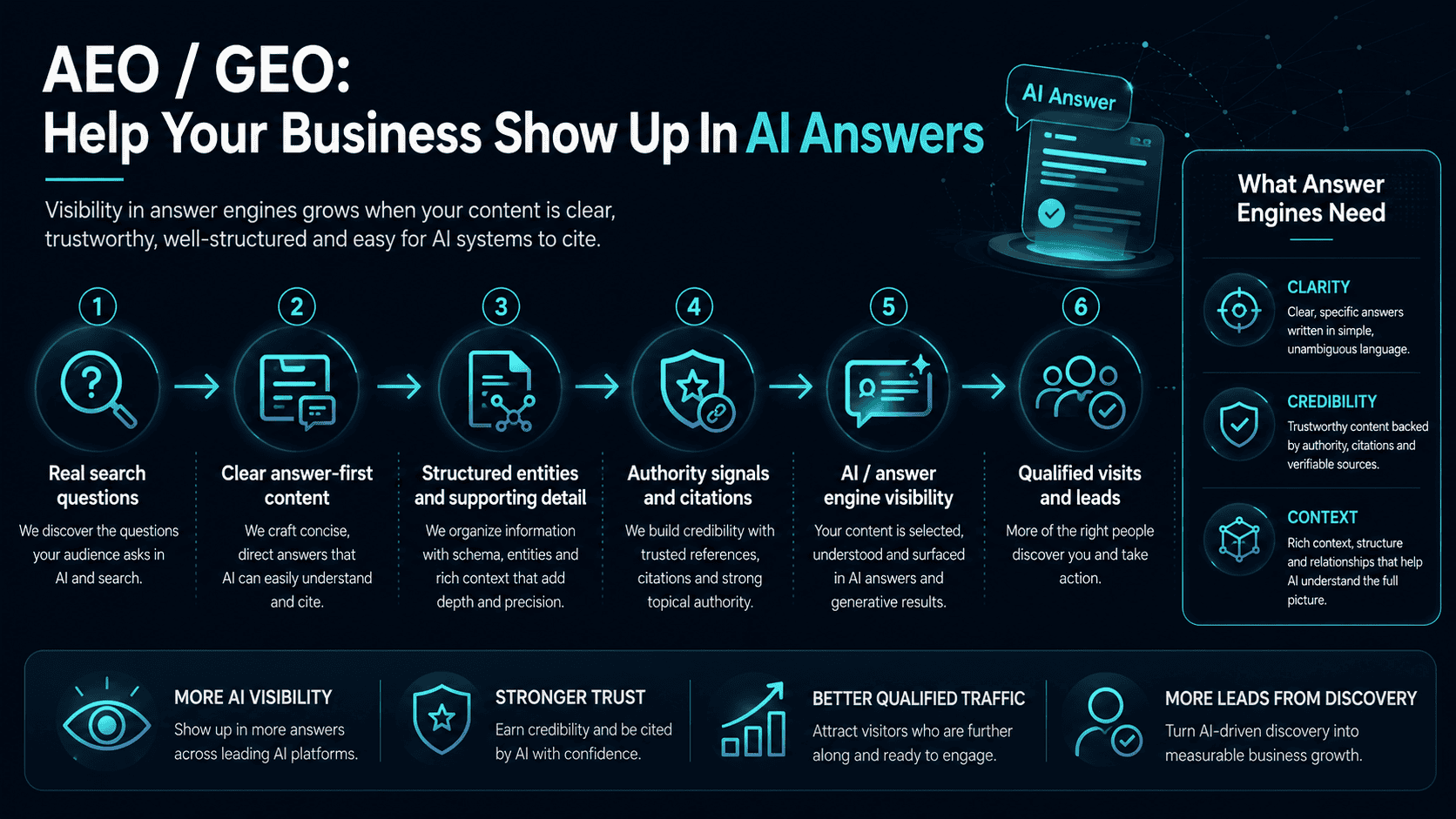
AEO and GEO strengthen the path from crawlable content to clear answers, entity understanding, citations and corroboration.
Let’s build something useful
Start with the business entity and the questions that matter. Automation comes after clarity.