
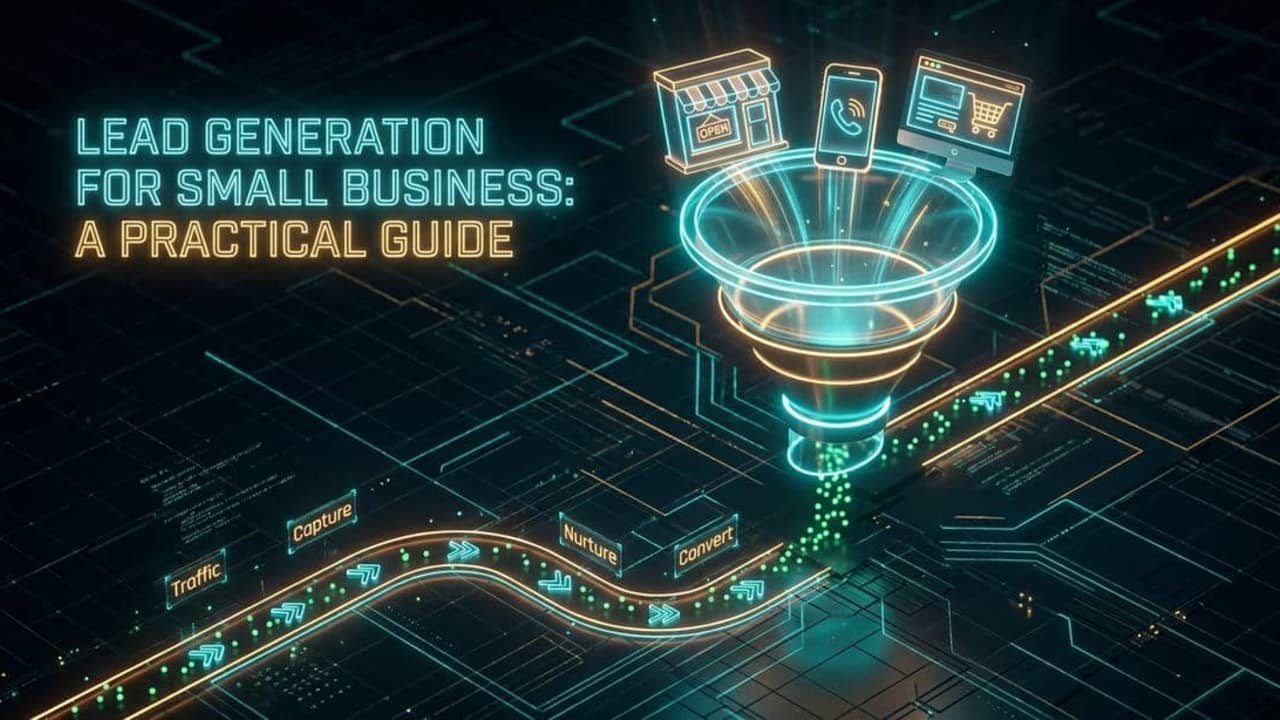
Most small businesses do not have a lead problem. They have a lead leak problem. Enquiries arrive through a dozen channels, get answered late or never, and quietly disappear. Fixing the system is often more profitable than finding more traffic.
This guide explains lead generation for small business in practical terms: how leads actually arrive, where they get lost and how marketing automation turns a leaky process into a dependable one.
What lead generation really means
Lead generation is the process of attracting, capturing and qualifying potential customers. It covers search visibility, paid campaigns, forms, calls, WhatsApp, referrals and every other point where a stranger becomes a contact.
Many businesses make the mistake of treating lead generation as one channel. In reality, it is a system. The channels feed the system, and the system decides whether a lead becomes a customer or disappears.
Where leads come from for small businesses
A typical South African small business receives enquiries from several places:
- Organic search, driven by SEO services and content.
- Local search, driven by Google Business Profile optimisation and local SEO.
- Paid campaigns, managed through Google Ads management.
- Calls and WhatsApp, often the highest-intent leads of all.
- Referrals and word of mouth, which can be encouraged systematically.
Each channel matters, but what happens after the enquiry is where most businesses lose money.
The lead leak: where enquiries disappear
Consider what happens with a typical web form submission:
- The customer submits a form at 9pm.
- The notification lands in a shared inbox.
- Nobody checks until 11am the next day.
- By then, the customer has called a competitor.
Speed of response is critical. Research consistently shows that businesses responding within minutes win far more of the enquiries than those who respond within hours. Every minute of delay is a point in the competitor's favour.
Add to that the quieter leaks: forms that silently fail, emails that go to spam, leads that arrive but are never assigned to anyone, and follow-ups that never happen. Together, they can waste a third or more of your marketing budget.
How lead generation automation fixes it
Marketing automation replaces guesswork with a reliable process. A well-built lead system can:
- Capture form submissions and route them to the right person instantly.
- Send an immediate acknowledgement to the customer, setting expectations.
- Log the lead in your CRM with the source attached, so you know what works.
- Create follow-up tasks so no lead is forgotten.
- Trigger reminders, quotes and nurture sequences without manual work.
This is exactly what our lead generation and marketing automation service delivers. It connects forms, CRM routing, follow-ups and task assignment into one dependable workflow.
Measure what arrives, not just what you send
Many businesses track spend but not results. The fix is conversion tracking: knowing which channel, which page and which campaign produced each enquiry.
With tracking in place, you can stop guessing and start allocating budget where the enquiries actually come from. You can also detect problems early, like a form that stopped working or a campaign attracting the wrong audience.
If paid traffic is part of your mix, verify its quality too. A PPC traffic quality audit reveals bot traffic and wasted clicks that no amount of follow-up can save.
Build the website to convert
Lead generation starts before the form. Your website design and landing pages decide whether visitors become leads in the first place. A fast, clear page with a visible contact path converts more of the traffic your marketing creates.
And when you are too busy to answer every call, an AI voice and chat receptionist captures the enquiries your team would otherwise miss. Combined with automation, it closes the gaps in the system.
A practical starting point
You do not need a complex martech stack. Start with the basics:
- Audit where your enquiries currently arrive and where they get stuck.
- Fix the leaks: forms, email delivery, response speed, assignment.
- Add tracking so you know which channels produce real leads.
- Automate the follow-up so no enquiry waits longer than it should.
- Then increase traffic, because the system can now handle it.
Common lead generation mistakes
Most small businesses make the same mistakes with lead generation. Recognising them is the first step to fixing them:
- Relying on one channel. If all your leads come from one source, you are one algorithm change away from no enquiries.
- No tracking. Without tracking, you do not know which channel, page or campaign produces the best leads.
- Slow response. Every minute of delay costs you a percentage of conversions. Research shows that responding within five minutes dramatically improves conversion rates.
- No follow-up system. Many leads arrive, get a single response and then disappear because nobody follows up systematically.
- Ignoring existing customers. Repeat business and referrals are often the cheapest and highest-quality leads, but they are not actively cultivated.
Fixing these mistakes does not require a large budget. It requires a system. A lead generation and marketing automation service builds that system around your existing traffic and enquiry channels.
Choosing the right tools for lead generation
The toolset for lead generation depends on the complexity of your business. A simple service business may need only a form, an email notification and a CRM to track follow-ups. A larger business with multiple services and salespeople needs more sophisticated routing, automation and reporting.
Common tools in a lead generation stack include:
- Forms on your website, connected to your email or CRM.
- CRM software to track leads from first contact to sale.
- Email automation for follow-up sequences and nurture campaigns.
- Call tracking to connect phone enquiries to specific campaigns.
- Analytics to measure which channels produce the best leads.
You do not need every tool. Start with the ones that solve your biggest leak, then add as the budget and complexity grow. The right starting point is a clear understanding of where your leads currently come from and where they disappear.
Connecting lead generation to your website
Your website is the centre of your lead generation system. Every channel, search, social, paid, referral, points to your site. If the site does not convert, the system leaks at the most critical point.
A static website design that loads fast and presents a clear path to contact is the best foundation. Add landing pages for specific campaigns, and a AI voice and chat receptionist to capture calls and chats that arrive outside business hours. Together, they form a complete lead capture system that works 24/7.
Where small-business enquiries actually get lost
Most small businesses do not have a lead problem so much as a leak problem. Interest exists, traffic arrives, and then the enquiry quietly fails somewhere between the first click and the first reply. Fixing lead generation starts with knowing exactly where that happens.
The gap between a visit and an enquiry
A visitor who is ready to make contact still has to cross a small gap between wanting to ask and actually asking. Every extra step widens that gap. A form with nine required fields, a phone number buried in the footer, a quote button that leads to another page of reading, or a contact page with no clear next step: each one quietly costs you a share of the people who were already interested.
The leaks are usually boring. Nobody answers the phone outside business hours and there is no message route. The form asks for a budget before the visitor knows what anything costs. The only contact address is a shared inbox that several people assume someone else is watching. None of this is dramatic, which is exactly why it survives for years.
Start with the basics: one obvious contact route on every page, a short form that asks only what you need in order to reply, a tap-to-call number on mobile, and an after-hours message that tells people when they will hear back.
Response time and the value of the first reply
The first reply does more work than any other message you send. It tells the customer whether they are dealing with a business that is paying attention. Harvard Business Review's 2011 article "The Short Life of Online Sales Leads" reported that firms which tried to contact a lead within an hour were nearly seven times as likely to qualify it as firms that waited longer. The Lead Response Management study, led by Dr James Oldroyd, found the same pattern at a finer scale, with replies inside five minutes performing far better than replies half an hour later.
You do not fix this by asking your team to try harder. You fix it with a system: an automatic acknowledgement the moment a form is submitted, a notification that reaches a named person rather than a shared inbox, and a rule that every enquiry gets a human reply inside a defined window. If you cannot staff that window, say so on the form and offer a booking link instead of silence.
What a missed enquiry costs over a year
Leakage is easy to ignore because it happens one enquiry at a time. Work with your own numbers rather than a rule of thumb. If your website produces ten enquiries a month and two of them fall through the cracks, through a form that fails silently, a call nobody returns, or a quote that never gets sent, that is twenty-four lost opportunities a year. Multiply that by your average job value and the figure stops feeling small. Multiply it again by the referrals those customers would have brought and it starts to look like a second marketing budget.
The exact number matters less than the pattern: the loss is recurring and invisible. Money spent on advertising and content appears on an invoice. A missed enquiry does not. That asymmetry is why businesses keep buying more traffic to solve a problem that actually lives in the follow-up.
Turning a captured enquiry into a booked job
Capturing an enquiry is only the middle of the process. A lead becomes a booked job when someone qualifies it, offers a time, and keeps following up until the customer decides. Qualification means asking the questions that separate a real job from a curious click: what the work is, where it is, when they need it, and whether the budget is in range. Ask those early and honestly, and you save everybody time.
Booking should be one step, not a negotiation. Offer two or three concrete slots instead of asking the customer to suggest a time. Then keep a short follow-up sequence running for the people who go quiet: a reminder, the quote, a check-in a week later. Most small businesses stop after one message. A system does not get bored, and that persistence is where a large share of booked work comes from.
Let us build a lead system that captures every enquiry.
Forms, CRM routing, instant responses and follow-up tasks, connected to the traffic you already generate.
Build my lead systemThe bottom line
Lead generation for small business is not about buying more traffic. It is about making every enquiry count: capturing it, responding fast, routing it properly and following up until the customer decides. Fix the system first, then scale the traffic. That is the sequence that makes marketing spend actually pay.